The short answer, up front
LinkedIn Sales Navigator automation belongs at the end of your outreach prep workflow — after enrichment, after verification, after intent filtering, and immediately before a human reviews what the agent drafted. Put it first and you automate noise at scale. Put it last-before-the-human and you automate reach with a filter already standing in front of it.
The number that made me care: in our Q1 2024 tooling audit, we paid to enrich roughly 4,200 contacts per quarter and a rep actually touched about 1,100 of them. That's a 74% waste rate — and it wasn't the automation wasting the money. It was the inputs we fed it.
Here's the thing: almost every “how to build an outreach workflow” piece starts with the sequence. I'd start with the invoice.
Why you're hearing this from someone who signs the invoices
Procurement manager at a 140-person B2B SaaS company. I've managed our go-to-market tooling budget — about $310,000 annually across sales engagement, contact data, and CRM — for six years, negotiated with 30+ vendors, and documented every order in our cost tracking system.
I don't run sequences. I approve the tools that run them. So I mostly meet the failure modes after they've turned into line items.
The Q1 2024 credit overage changed how I think about prospecting tools. We were on a consumption-based enrichment contract with a monthly credit pool. Sales burned through it by the 19th, twice, and then quietly throttled themselves for the back half of the month. Nobody escalated, because from a rep's seat it just looked like the tool had gotten slow.
And honestly, everything I'd read about choosing a B2B contact data platform said the same thing: buy the biggest, broadest provider and let the platform sort out deduplication. In practice, for our segment — mid-market fintech, US and Canada — waterfalling two mid-tier sources plus a separate verifier beat the single enterprise contract on coverage and on cost. Not by a little. The annual difference was around $47,000 — no, $41,000, I'm mixing it up with the CRM consolidation. Either way, it came out of the data layer, not the automation layer.
The workflow order that holds up in a budget review
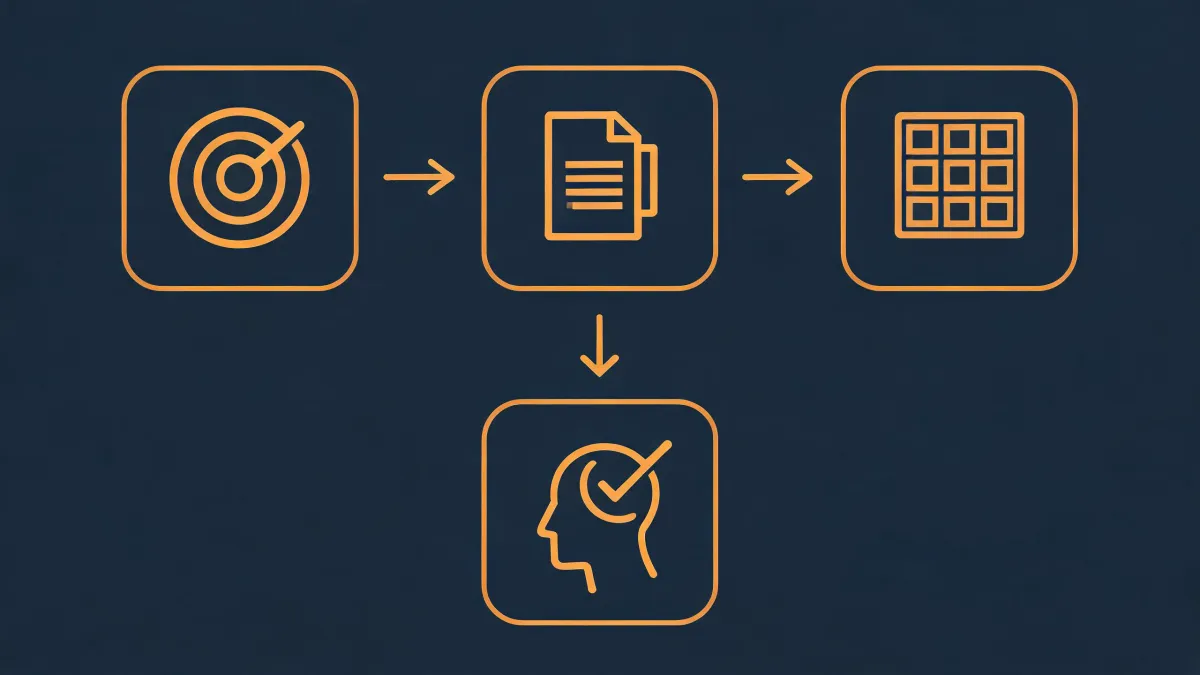
Five steps, in this order. The position of step four is the whole point.
- Narrow the segment before you pull a single record. Ours was roughly: fintech or adjacent, 200–2,000 employees, US or Canada, on a modern CRM, hired an SDR in the last twelve months. The narrower the input, the less every downstream layer has to compensate for sloppy targeting.
- Build the list with waterfall enrichment. Query source A, fill the gaps from source B, fill what's still missing from source C. Cost per record goes up; the number of records you need goes down. Ours fell from about 4,200 per quarter to roughly 1,600.
- Verify before the records touch a sequence. Not after a bounce spike. Five minutes of verification beats five days of deliverability cleanup. And to be clear, no verifier is perfect — the goal isn't pristine data, it's catching the dead addresses and role accounts before they get anywhere near your sending domain.
- Layer intent on top of the filtered list. Job changes, hiring signals, tech stack movement, content engagement. This is usually where 1,600 becomes 350.
- Then the LinkedIn Sales Navigator automation, and then a human.
Sales Navigator is the most expensive per-record layer you own — seat-based pricing stacked on top of your data spend — and the most fragile one operationally. LinkedIn's User Agreement restricts automated messaging and scraping, so the legitimate surface is the CRM sync and the official enterprise API. Verify current terms before you build anything on it. That fragility is exactly why it goes late: you feed it only the accounts that survived steps one through four.
What that looks like in practice depends on the tool. Something built around an agent-native prospecting workflow — okki-go is the one I looked at most closely when we re-evaluated our stack — chains the prep steps so the output of enrichment becomes the input of verification, which becomes the input of intent scoring, and the LinkedIn layer receives a filtered set instead of a raw export. The alternative is four CSV exports stitched together in a spreadsheet by whoever on the RevOps team has the least to do that week.
To be fair: a spreadsheet-and-checklist process run by someone who actually owns it will beat a five-tool stack run by nobody. I'm arguing about sequencing, not about buying software.
Then a human approves before anything sends. Human-in-the-loop sounds like a nice phrase until you price out skipping it — a bad first line, sent to 350 people at once, on a domain you spent three weeks warming. We ran the pilot in Q3 2024. I should add that we had a RevOps analyst with real capacity that quarter, which most teams our size don't have.
One reversal worth sitting with. The standard assumption is that better data produces more meetings. In our numbers it ran the other way — the quarters where we booked the most meetings were also the quarters where someone had spent actual time on data hygiene. I think what's happening is partly that winning teams have the slack to invest in hygiene, and partly that hygiene genuinely helps. I wouldn't claim more than that from four quarters of internal data.
Where the budget actually leaks
Three line items: seats. Credits. Verification. Only one of them is negotiable, and it usually isn't the one teams push on.
Verification is per-unit and visible, so it's the first thing cut when a finance review lands. That's the wrong order. Cutting verification doesn't remove the cost, it relocates it — into bounce rates, into domain reputation, into rework. What I mean is that the “cheap” option isn't cheap, it's just billed to a different month, and the month it lands in is usually the one where you've already committed to a campaign calendar you can't move.
We built a pre-load checklist after our second credit overage. Nine items, all boring: domain verified, catch-all domains excluded, role accounts removed, dedupe run, consent basis documented, sending domain warmed, daily cap set, reply routing tested, named owner on the campaign. It takes about fifteen minutes per campaign. I'd put the rework it prevented last year somewhere in the $6,000–$9,000 range. Take that with a grain of salt — it's my own tracking, not an audited figure — but fifteen minutes to avoid that range is not a hard call.
For okki-go-style evaluations with SDR teams, the question I'd ask any vendor is not “how many contacts does this platform have.” It's “how many of those contacts will a rep actually touch, and what does the untouched remainder cost me per quarter.” That question killed two tools in our last cycle.
When this order doesn't apply
Three situations where I'd tell you to ignore everything above.
Under five quota-carrying reps. Waterfall enrichment is overkill at that size. One decent source plus a verifier gets you most of the coverage, and the fixed cost of managing multiple vendors — contracts, invoices, seat minimums, integration maintenance — will exceed what the extra coverage is worth. I'd wait.
Single-vertical, single-geo, small total addressable market. If your entire universe is 3,000 accounts, you'll saturate the list in a quarter. The bottleneck is messaging, not data. Spend there instead.
No one owns data hygiene. This is the one I feel strongest about. Adding enrichment layers and intent scoring to a team with no owner for dedupe rules and suppression lists makes things measurably worse — you get more plausible-looking records flowing faster into the same broken process. Fix the ownership question first. It's free.
Two caveats I'd be negligent to leave out. If you're prospecting into the EU or UK, GDPR applies — legitimate interest can cover some B2B outreach, but it isn't automatic and it needs a documented assessment plus a working opt-out path. For US commercial email, CAN-SPAM compliance is mostly honest headers, a working unsubscribe, and honoring opt-outs within 10 business days (Source: FTC, CAN-SPAM Act compliance guide; verify current requirements). Talk to counsel, not a blog. And on LinkedIn specifically, confirm current terms before automating anything that touches messaging; the rules have tightened over the years and I'd rather you check than assume.
I'm a procurement person, so my bias runs toward fewer tools with clearer ownership. Read the above with that in mind. But the 74% waste rate wasn't a matter of opinion — it was sitting in the usage report, and it took one afternoon to find.