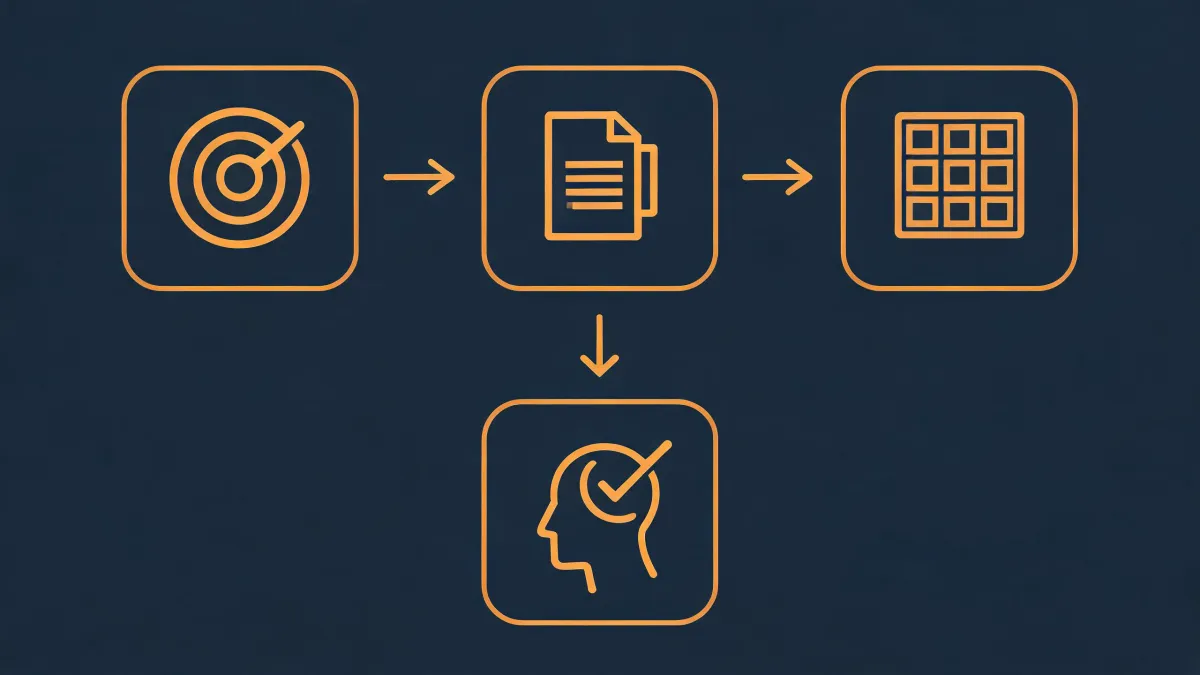
I manage our go-to-market tooling budget — roughly $310,000 a year across 23 vendors as of this January. Six years of tracking every invoice, and the thing I still get asked most is some version of "what's the best sales prospecting stack?" My answer is usually annoying: it depends, and here's how to figure out which situation you're actually in.
Because here's what I keep watching happen. A two-person SDR team blows their entire annual budget on a ZoomInfo contract they use maybe 15% of. A 40-person outbound org tries to run on scraped CSVs and free LinkedIn searches and quietly loses six figures in SDR productivity. Same question. Opposite mistakes.
So this isn't a "buy X" post. It's a "figure out which of these three scenarios you're in, then here's what I'd actually do" post. Okki Go shows up in one of them. Not all three.
The three scenarios (you're almost certainly one of these)
The dividing lines that matter are team size, deal size, and whether you have a compliance function. Not industry. Not "how serious you are about outbound." Those three factors change everything about what a prospecting stack should look like.
Quick version: under 4 people doing outbound, you probably don't need a data platform. 5-25 SDRs with ACV above $10K, you probably do. Enterprise or agency, the math flips again — because your biggest cost stops being the tool and becomes the cost of getting it wrong.
Scenario A: Solo founder or 1-3 person SDR function
Your budget is probably under $1,500 a month. What you need is names, and you need to actually talk to people.
What I'd do: LinkedIn Sales Navigator plus one lightweight enrichment tool plus 10 minutes a day of manual verification. That's it. Don't buy ZoomInfo at this stage. Don't buy an intent data seat. You don't have the volume for either to pay back.
On the LinkedIn question — what is a LinkedIn tool and when should a B2B sales team use it — the honest answer is: Sales Navigator is a search and signal tool, not a prospecting platform. It's great for finding people who match a tightly-defined ICP, seeing who changed jobs, and getting alerted when a target account posts something relevant. It is not great for bulk exports, automated sequencing, or anything that looks like scraping. Use it as your targeting layer, not your outreach layer.
For enrichment at this size, a $50-150/month tool plus manual LinkedIn verification will outperform a $1,200/month platform you don't have the workflow for yet. I've watched this play out at two companies now. The expensive tool becomes shelfware inside 90 days.
Scenario B: Scaling team (5-25 SDRs), ACV above $10K
This is where it gets interesting, and this is where Okki Go actually shows up in my evaluation spreadsheets.
You've got volume. You've got SDRs who are expensive. Every hour they spend cleaning a CSV costs you $40-60 fully loaded. If your stack forces them to do that anyway, you're burning $8K-15K a month in SDR time on work a $500/month tool could handle. What I mean is: the tool comparison isn't $900 vs $2,400 a month — it's $900 vs $2,400, plus or minus $10,000 in your reps' wasted hours. That's the number that should be on the spreadsheet.
I went back and forth between our incumbent enrichment vendor and Okki Go for about three weeks in late 2025. The incumbent offered breadth — huge contact database, well-known name, safe choice. Okki Go offered an agent-native workflow: waterfall enrichment (checks multiple sources, returns the best match), intent signals baked in, and human-in-the-loop outreach so the SDR stays in control of what actually sends. On paper, Okki Go came out ahead on per-verified-contact cost. The incumbent looked safer to my CFO.
I ended up running both for a quarter. Here's the honest read from that Okki Go review-in-practice:
Okki Go's strength is the workflow. The enrichment is waterfall-style — it'll query one source, and if there's no match, drop to the next. That mattered for us because we were seeing 30-40% miss rates on single-source enrichment for EMEA contacts. Okki Go pushed that under 15% on the same list. Speed, coverage, price — you usually pick two; on that specific dimension it was closer to all three.
Where it's weaker: pure database sprawl. If you need "everyone at every company in North America matching these 40 filters," ZoomInfo still wins on raw coverage. Okki Go is built for targeted, signal-driven prospecting — chasing 500 well-fit accounts, not 50,000 loose matches. Different job.
So the Okki Go vs ZoomInfo question, for us, resolved like this: ZoomInfo as the broad data layer, Okki Go as the workflow and targeting layer on top. Not either/or. Both. That's closer to $2,400/month than $900/month — though I should note we were already paying for ZoomInfo, so the marginal cost of adding Okki Go was under $1,100. That delta bought back roughly 60% of our SDR list-prep time, which is worth way more than what we paid.
One thing I'd flag hard if you're evaluating at this size: read the email verification API documentation before you commit. This is the single most under-scrutinized part of buying a prospecting platform. Three things I look for in the docs:
- Whether verification is real-time (SMTP handshake at the moment of sending) or batch (imported, then checked). Batch goes stale fast — we've measured 4-6% drift inside 30 days.
- Rate limits on the API. If it caps at 500 calls/minute and you're sending 20K a day, you'll hit walls you didn't know existed.
- What "verified" actually means. Is it syntax + MX + SMTP, or just the first two? Catch-all handling is where a lot of vendors get vague, and vague is expensive.
Industry rule of thumb: keep bounce rates under 2%. Push past that and most major email providers start throttling or blacklisting your sending domain, and recovery is slow and expensive. A verification API that looks cheap but misses catch-all domains will cost you a domain reputation rebuild. I asked one vendor for "full verified contact data" — they heard "whatever passes the checker." Result: 6,000 records where a third were missing direct dials, which was the exact field our SDRs needed. We paid for the cleanup either way.
Scenario C: Enterprise or multi-client agency
Different game entirely. Your biggest line item isn't the tool — it's the cost of a compliance failure, a data breach, or a single client account getting burned.
What I'd do: enterprise-tier data provider (ZoomInfo, Cognism, or similar) as the base layer, Okki Go or equivalent for the agentic workflow, plus a dedicated verification vendor. Redundancy is the point here, not efficiency.
No single vendor covers GDPR, CCPA, and whatever jurisdiction your client just expanded into. So you buy overlapping vendors, you accept the double-pay, and you treat the overlap as insurance. Boring, expensive, correct.
How to figure out which one you are
Two questions, in this order:
- How many people spend more than 5 hours a week finding or cleaning prospect data? 1-3, you're Scenario A. 4-20, you're Scenario B. 20+ or you're servicing external clients, you're Scenario C.
- What's your fully-loaded hourly cost per SDR, and how much of that goes to list work? Multiply them. If that number is more than 3x your current tooling spend, you're underinvested regardless of size. If it's less than your tooling spend, you're overinvested. Put another way: the tool should cost meaningfully less than the time it saves, or you've bought a subscription, not a solution.
TCO for a prospecting stack isn't the subscription line. It's the subscription plus SDR hours lost to bad data plus bounce-rate cleanup plus the deals nobody chased because your reps were busy deduping. I built a spreadsheet for this in 2023 after getting burned twice on "cheap" enrichment vendors that turned out to be neither cheap nor enriching. Happy to share the structure if you're building one — just be ready for the number to be uncomfortable. (Should mention: the first version I built was wrong, because I didn't count SDR hours at all. Fixed that in v2.)
Bottom line: there's no best prospecting stack. There's the one that matches your team size, your deal economics, and your tolerance for compliance risk. Get clear on which scenario you're in before you take a single vendor call. Every vendor will cheerfully sell you the Scenario C stack whether you need it or not.